

Abstract:
Postbellum coal production rapidly increased as railroad companies expanded from contract carriers to owner-operators of rich coal fields in West Virginia and Virginia. Famous fallen flag railroads such as the B&O, The Chesapeake, and Ohio as well the Norfolk &Western (today’s Norfolk Southern Railway) developed remote but productive bituminous collieries and linked them to trunk lines. The period 1870-1890 witnessed the development of high-temperature processed bituminous coal, known as “coke,” that became the fuel for the burgeoning iron and steel industries. Major technological improvements in extraction, ventilation, and pumping greatly improved mining yields during this period.[1]
Background
Deep shaft coal had been a source of fuel for Great Britain since the early 1500’s, North American colonists had little need for mineral fuel. During the colonial period of the seventeenth and eighteenth centuries, the vast forests of British North America provided colonists with abundant supplies of wood. As eastern seaboard cities grew in size, wealth, and increased distance from available woodlands industry and homes began to look seek out domestic coal to fuel their forges and stoves. Deposits of anthracite coal or “stone coal” had been discovered in the Richmond Basin in eastern Virginia and near Pittsburgh along the Monongahela River. This type of hard coal product rapidly took control of consumer demand than the softer bituminous coal then in use in British cities. Anthracite was a higher temperature burn and became the fuel of choice of bakers, brewers, blacksmiths, and metallurgists. Further, consumers in the home around their Franklin stoves noticed the lack of noxious smoke as the anthracite burned and warmed more efficiently. During the period following independence, influential economic nationalist voices of the period such as Albert Gallatin and Alexander Hamilton argued that coal, not forests, would ensure the future strategic fuel for growth and national independence.[2]
American Coal in the mid to late 19th Century
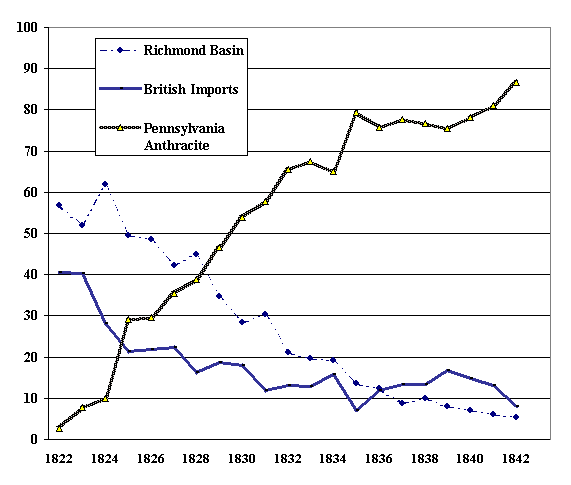
By the 1840s, American anthracite coal was powering the early railroads and other steam-powered industries. By 1842, as Chandler illustrates in the graph below, (Chandler, 154) Pennsylvania anthracite dominated the eastern urban market with over one million tons extracted and shipped by rail or canal as annual anthracite exceeded British bituminous coal production by almost ten times. Fifty-six percent of all pig iron smelted in the nation was done using anthracite coal. By the advent of the Civil War, coal was a leading industry in twenty of the thirty-three US states. [3]
From 1860 to the Fin de Siecle
To meet the increased demand for coal in the boom-and-bust decades following the Civil War, mining companies were required to dig deeper shafts, often below aquifer lines. As a result, coal companies required large amounts of capital to meet the technological challenges presented with extraction at increased depths. Innovative steam-powered systems of ventilation, water pumping,
and more efficient extraction methods were required in order to remain competitive. Electric cutting machines in the early 1890s replaced the dangerous blasting methods used to bring down even larger subterranean coal seams. As the mining technologies born of the Industrial Revolution in America progressed so did the increased production of coal that fueled it. For example, the end of the century saw consumption patterns of coal take a significant upward turn as a process of using high temperatures to bake impurities from bituminous coal produced a new metallurgical derivative that could be used to fuel the blast furnaces the iron and steel industry known as “coke.” From 1880 to 1900, coke production in the US increased from three to twenty million tons per annum.
Consumption patterns also changed. The late nineteenth century saw the emergence of coke — a form of processed bituminous coal in which impurities are “baked” out under high temperatures — as a powerful fuel in the iron and steel industry. The discovery of excellent coking coal in the Connellsville region of southwestern Pennsylvania spurred the aggressive growth of coke furnaces there. By 1880, the Connellsville region contained more than 4,200 coke ovens and the national production of coke in the United States stood at three million tons. Two decades later, the United States consumed over twenty million tons of coke fuel. Throughout the later Industrial Revolution period, coal prices remained low as a result of high demand, low-profit margins, and vicious competition between the railroads who owned the fields. To meet ever-increasing demand, the number of coal fields increased and were integrated into the railroads. Famous fallen flag railroads such as the B&O, The Chesapeake & Ohio, as well the Norfolk &Western (today’s Norfolk Southern Railway) developed remote but productive bituminous collieries and linked them to trunk lines. By 1895, “King Coal” employed more than 300,000 miners. While the industry went unchallenged as the fuel supplier to the nation, tensions increased between management and its workforce.[4]
[1]Adams, Sean Patrick. “The US Coal Industry in the Nineteenth Century”. EH.Net
Encyclopedia, edited by Robert Whaples. January 2003. URL
The US Coal Industry in the Nineteenth Century
[2] Nye, David E.. Consuming Power: A Social History of American Energies. Cambridge:
Massachusetts Institute of Technology Press, 1998.
[3] Chandler, Alfred. “Anthracite Coal and the Beginnings of the ‘Industrial Revolution in the The United States,” Business History Review 46 (1972): 141-181.
[4] Adams, Sean. “US Coal Industry in the Nineteenth Century”, 2003.